
Best Answer:
The notes on the 4 spaces are A, C, E, & G. The notes on the 5 lines are G, B, D, F, & A. Say the note names on the Spaces going from the bottom to the top several times. Then do the same thing with the notes on the Lines, again going from the bottom to the top.
FAQ
How do you explain music notes to kids?
How to Teach Music Notes to Kids
- Say the Note Names Out Loud While Practicing. When your young beginners are just starting out, you can assign them to say the letter names while they practice.
- Hold Studio Flashcard Challenges. Piano students always love a challenge with a reward at the end!
- Play Note Name Games.
How do you teach a beginner to read music?
5 Tips For Learning To Read Music For The Beginning String…
- Think of Music as a Language.
- Focus on the Basic Symbols.
- Count Silently Every Time You Read.
- Practice Reading Music without Your Instrument.
- Pace Yourself.
What age should a child learn to read music?
age 4Childhood development stages determine one’s ability to read, and most students can learn to read music around the same time they learn to read language, around age 4 or 5.
How do you teach basic music theory to kids?
Top 11 Music Theory Activities for Kids
- Teach Music Theory to Popular Songs.
- Use Flash Card Games.
- Learn Through Play.
- Encourage Children to Compose.
- Cosmic Whole Note Game.
- Music Theory Treasure Hunts & Activities.
- Explain Cadences Through Popular Songs.
- Listening to their Favourite Music For Homework.
What is learning to read music called?
This is called “intervallic reading” by music teachers, and refers to the ability to visually track from one note to the next and recognize how the notes are changing. When an advanced pianist is sightreading a new piece, she doesn’t take time to think of the letter name for each note.
What are the 7 musical notes?
In the chromatic scale there are 12 tones including 7 natural musical notes (A, B, C, D, E, F, and G) and 5 sharp/flat notes ( A#/Bb, C#/Db, D#/Eb, F#/Gb, and G#/Ab). They each represent a different frequency or pitch.
What is the fastest way to learn to read music?
Recognizing intervals is a quick and practical way to learn how to read sheet music because your fingers respond to the shape of the music. By recognizing common shapes and patterns, you will not have to think as much, and will therefore speed up your processing time, making you a faster reader.
How long should it take to learn to read music?
Some will become proficient at reading sheet music after two or three months of consistent practice, but it may take a decade to really get to grips with it. On average, it takes a beginner eighteen months to two years to reach that level.
Does music instruction help children learn to read?
Children in the first grade had higher scores in reading comprehension when they were concurrently taught music-reading skills. Children in second grade who were exposed to music-reading instruction were significantly better in both read- ing vocabulary and reading com- prehension.
Why can’t my 7 year old read?
The most common indicator that a child will struggle with reading is whether they have a family history of reading or learning issues, or dyslexia, says Truch. “We do know from research in the last 20 years that there’s a heavy genetic component to reading difficulties,” he says.
What are the five steps to reading a piece of music?
5 Steps to Sight Reading Sheet Music
- Get your materials ready.
- Highlight all the accidentals.
- Mark the rhythms that seem difficult.
- Scan over the whole piece before you play.
- Read the music in your head first.
What is the easiest way to memorize music notes?

What are signs of a struggling reader?
What to look for:
- Difficulty rhyming.
- Difficulty hearing individual sounds.
- Difficulty following directions.
- Difficulty re-telling a story.
- Struggles to sound out most words.
- Avoids reading aloud.
What causes poor reading skills?
What causes poor reading skills? There are various factors that lead to reading failure, including impoverished exposure to language and early literacy activities, lack of adequate instruction, and/or more biologically based risk factors.
What are the four fundamentals of music?
- Overtone: A fundamental pitch with resultant pitches sounding above it according to the overtone series.
- Timbre: The tone color of a sound resulting from the overtones.
- Pitch: The frequency of the note’s vibration (note names C, D, E, etc.).
- Amplitude: How loud or soft a sound is.
What part of the brain is involved in reading music?
The recognition and understanding of pitch and tone are mainly handled by the auditory cortex. This part of the brain also does a lot of the work to analyze a song’s melody and harmony.
What are the tips to read music?
10 Tips and Tricks for Sight Reading Music
- Familiarize Yourself with a Variety of Rhythms.
- Memorize Key Signatures.
- Know Your Scales.
- Practice Without A Saftey Net.
- Practice Sight-Reading Different Types of Music.
- Examine The Piece You’re Sight-Reading.
- Identify Annotations in the Piece.
How do you teach piano notes to kids?

What is the fastest way to memorize music without playing?
10 Tips for Memorizing Music
- #1. Start small. This might go without saying, but building your memory is a process.
- #2. Use sight reading tips.
- #3. Play it through.
- #4. Use your other senses.
- #5. Visualize the music.
- #6. Watch your hands.
- #7. Write it down.
- #8. Hum, solfege, or hear the piece.
What is the rhyme to remember music notes?
A mnemonic for notes in spaces is FACE. You can even use your hand as a mnemonic: fingers are lines. For the bass or F clef, for notes on lines: GBDFA – Grizzly Bears Don’t Fear Anything, or Good Burritos Don’t Fall Apart, and for notes in spaces between the lines, All Cows Eat Grass.
How do you teach rhythm notes?
Simply clapping along with the pulse of the music works wonders. Start with singing simple songs and clapping along. Your students can also try clapping along while you play the piano. The perception and performance of rhythmic movement bring together several different brain functions.
Why is reading music so hard?
It takes time to learn the sounds of each letter, how to combine letters into words, and then read your favorite novel. It’s the same with reading music. It takes time to learn the names of each individual note, then combine notes into chords, and make all this fluent like you reading a book.
How long does it take to memorize music notes?
Once an average piece is learned thoroughly, it takes about a month to memorize it. However, this can vary widely, so there really isn’t a hard and fast time frame. What are the four kinds of memory? The four kinds of memory are visual, auditory, analytical, and muscle memory.
Is it hard to read music notes?
Many people believe it is hard to learn to read music. It isn’t! In fact, reading music is a little like learning to read another language, but much easier than most languages to learn!. In fact, if you are reading this – you can learn how to read music with just a little effort.
Is it hard to learn to read music notes?
Absolutely anyone can learn to read music with the right approach and some practice. Learning to read music is not hard – anyone who can read the alphabet of everyday language or read numbers already has the tools to learn how to read music.
Is learning to read music good for the brain?
In a recent study, scientists reveal further evidence supporting this brain-building tactic. Learning music early in life actually makes the brain more connected, inducing neural plasticity capable of improving neurological capabilities beyond music.
Does music help kids with ADHD study?
A study done in 2020 showed that music seemed to improve focus and attentiveness in children diagnosed with ADHD. Music therapy has been effective for people with ADHD because they crave the type of structure that music provides.
Do audio books help kids read?
Our review also includes evidence that listening to an audiobook requires the same cognitive skills as reading in print, and also supports the development of skills that children need to read including language comprehension and the ability to understand and retain information.
How can I teach my toddler to read music?

Why do ADHD kids have trouble reading?
Reading can be difficult and frustrating for children with ADHD. This is due to issues of focusing, managing distractions, and processing and retaining information. If the condition isn’t managed during childhood, reading challenges may continue into high school, college, and adulthood.
How do you teach music in Montessori?
Movement can be introduced through guided music and movement activities. Children in a Montessori classroom are exposed daily to music through materials such as the Montessori bells. Through the bells, children learn how to differentiate between sounds, which in turn helps with literacy and language development.
What are the three main elements of basic music theory?
The basics of music theory
Music is made up of three fundamental parts; Melody, Harmony, and Rhythm. Melody is a sequence of single musical notes arranged to please (or upset) the listener.
How is music taught in Montessori?
The idea that every child has musical potential and all children are able to learn and express themselves musically permeates the Montessori method. Music activities are respected at the same level as any other form of learning. Teachers are supportive and encouraging of the child’s musical endeavors.
Is it better to read music or memorize?
To prepare for a performance, and to develop your memory, memorization is important. This allows you to put more feeling into the performance, and to improvise a bit if appropriate. It is difficult to “perform” if you are only focused on the sheet music.
What is it called when you can’t read music?
You may have a condition called musical dyslexia (also known as dysmusia) This is a similar condition to dyslexia but involves difficulty with processing music notes rather than words.
How do you teach music staff to kids?

What are the 4 types of notes?
We’re going to learn four types of notes and rests; whole, half, quarter and eighth.
Why do music notes only go to G?
More than a thousand years ago the letters of the Roman alphabet were adopted to refer to these, and since there were only seven the letters ran A, B, C, D, E, F, G.
What are the 12 basic music notes?
Western music typically uses 12 notes – C, D, E, F, G, A and B, plus five flats and equivalent sharps in between, which are: C sharp/D flat (they’re the same note, just named differently depending on what key signature is being used), D sharp/E flat, F sharp/G flat, G sharp/A flat and A sharp/B flat.
Does music without words help you study?
Music Improves Focus and Concentration
To get the most benefit from your music, listen to music you enjoy. Classical or instrumental music with guitars or other string instruments might be less distracting, but you can use anything that’s not too fast or too wordy.
Should you listen to music while Memorising?
It could help you memorize new information
These findings suggest certain types of music can help boost memorization abilities and other cognitive functions. Music helps stimulate your brain, similar to the way exercise helps stimulate your body.
Should you listen to music while memorizing?
Benefits of Listening to Music While Studying. It enhances your attention. Having background music can help you focus. Studies have shown that listening to music improves your memory and this phenomenon is called the ‘Mozart Effect’.
How can music mnemonic be used to memorize?
You can make a song or jingle using any type of music you choose for any list of items. Music Mnemonics work best with long lists. For example, some children learn the ABC’s by singing the “ABC” song. Other children learn all the states in alphabetical order using the “50 Nifty United States” song.
What is a good example of music mnemonics?
An example of a musical mnemonic device would be the “ABC Song” that children learn when they are first learning the Page 17 8 English alphabet; the children connect the letters of the alphabet to the song and when the children try to recall the alphabet, the song will aid in the recall of the letters.
What is the trick for reading piano notes?
Learn the strings by remembering “Good Boys Do Fine Always.” For the spaces, remember “All Cows Eat Grass.” Each word corresponds to a note on the staff. By reading sheet music this way, you can begin figuring out where each note is on a piano. The bottom line corresponds to a G note, followed by a B, D, F, and A note.
How can I help my child learn rhythm?
To begin, you can play a beat (clapping, stomping, using simple percussion instruments, etc.) while your child listens, then they mimic the rhythm. You can begin with a simple pattern and gradually increase the complexity, movement requirements, and length.
How do I teach my child to read rhythm?
Tips for Teaching Rhythm
- Keep it simple.
- Clapping games like “Patty-Cake” and “Miss Mary Mack” can help a child learn rhythm cooperatively.
- Get their whole body into rhythm practice.
- Add language.
- Add musical instruments like drums and xylophones as fine motor skills develop.
How do you teach students musical notes?
Explicitly teaching music notation
- Begin a whole-class body percussion or bucket drum circle.
- Establish a simple beat.
- Create call and response rhythms between teacher and students.
- Increase rhythmic complexity and include student calling.
What type of music stimulates the brain?
Classical Music
Researchers have long claimed that listening to classical music can help people perform tasks more efficiently. This theory, which has been dubbed “the Mozart Effect,” suggests that listening to classical composers can enhance brain activity and act as a catalyst for improving health and well-being.
How does the Mozart effect work?
It is suggested that music with a high degree of long-term periodicity, whether of Mozart or other composers, would resonate within the brain to decrease seizure activity and to enhance spatial-temporal performance.
Are musicians left or right brained?
The ability to produce and respond to music is conventionally ascribed to the right side of the brain, but processing such musical elements as pitch, tempo, and melody engages a number of areas, including some in the left hemisphere (which appears to subserve perception of rhythm).
How do beginners read music for singing?

How long should it take to learn to read music?
Some will become proficient at reading sheet music after two or three months of consistent practice, but it may take a decade to really get to grips with it. On average, it takes a beginner eighteen months to two years to reach that level.
What are the five steps to reading a piece of music?
5 Steps to Sight Reading Sheet Music
- Get your materials ready.
- Highlight all the accidentals.
- Mark the rhythms that seem difficult.
- Scan over the whole piece before you play.
- Read the music in your head first.
How long does it take a child to learn piano?
It can be a process of about 6-9 years. Starting in the primary grades 1-3, after three years of lessons, a young student typically will be a solid elementary player, able to play simpler music with both hands.
How do you read simple music notes?
The top number tells you how many beats are in a measure, the space between each vertical line (called a bar). The bottom number tells you the note value (the length) of each beat. In the example above, the time signature is 4/4, meaning there are four beats per bar and that every quarter note gets one beat.
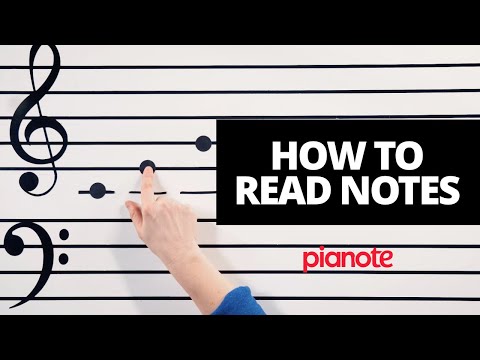
How do music notes learn for beginners?
What are the 7 keys in music?
In Western music, there are seven such scales, and they are commonly known as the modes of the major scale (Ionian, Dorian, Phrygian, Lydian, Mixolydian, Aeolian, and Locrian).
What are the 7 musical notes?
In the chromatic scale there are 12 tones including 7 natural musical notes (A, B, C, D, E, F, and G) and 5 sharp/flat notes ( A#/Bb, C#/Db, D#/Eb, F#/Gb, and G#/Ab). They each represent a different frequency or pitch.